


IN SEARCH OF THE SACRED RELICS OF EMPEROR-MONK TRAN NHAN TONG
While the Buddha's relics from India receive great attention from the Vietnamese people, many do not know that Vietnam also has a reliquary believed to belong to Buddhist Emperor Tran Nhan Tong

Buddhist Emperor Tower - The place enshrining the Relics of Buddhist Emperor Tran Nhan Tong, at Ngoa Van Hermitage - Pagoda - Dong Trieu City, Quang Ninh Province
And recently, Dr. Nguyen Van Anh (University of Social Sciences and Humanities, Vietnam National University, Hanoi) announced the discovery of the relics of Buddhist Emperor Tran Nhan Tong at Ngoa Van.
According to Dr. Nguyen Van Anh, historical records indicate that after Buddhist Emperor Tran Nhan Tong passed away, he was cremated by his disciples, leaving behind his precious remains and over 3,000 sarira pearls (relics). The Buddhist Emperor's relics were then divided into several portions and kept in various places for the people and Buddhists to worship and revere.
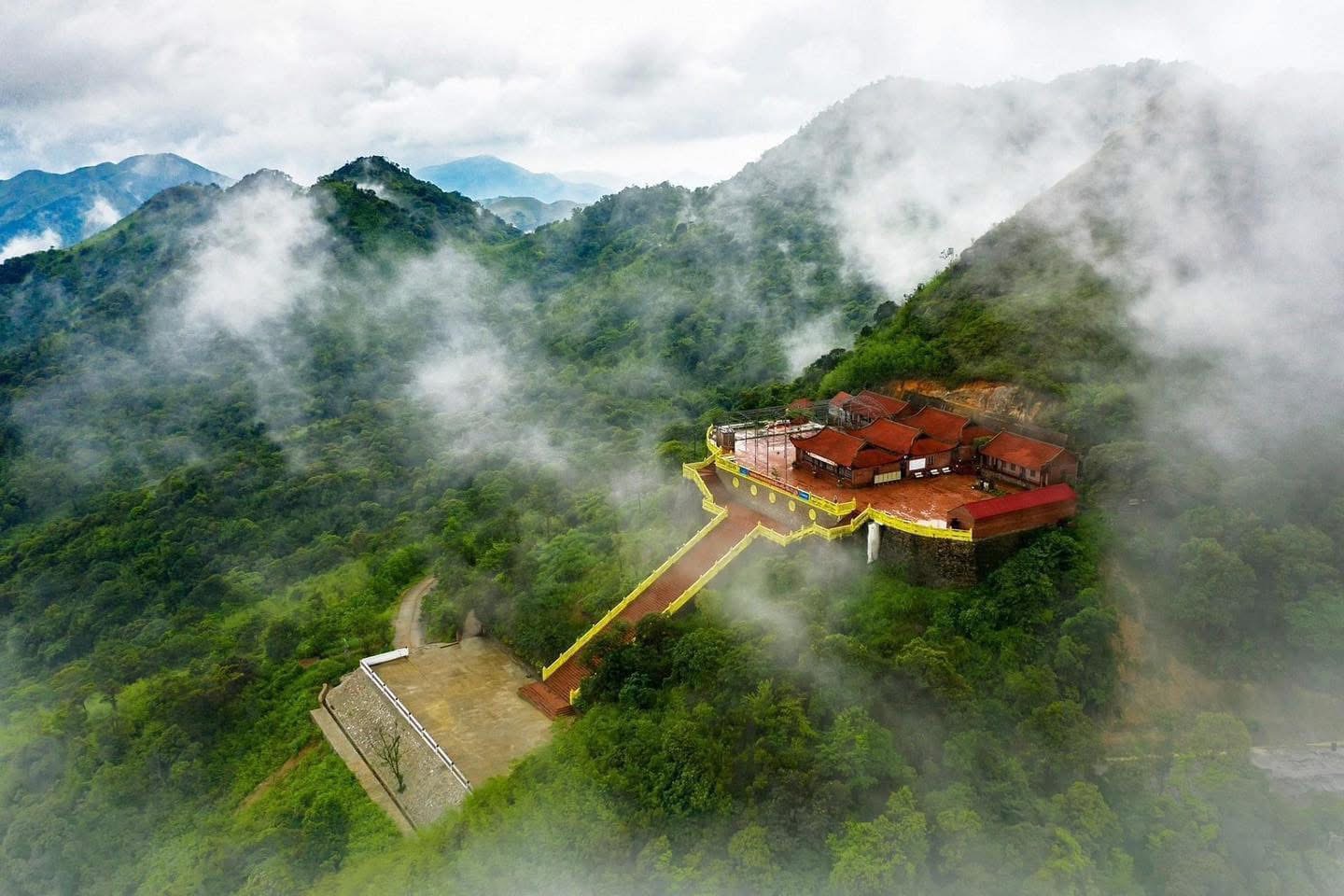
Middle Ngoa Van Pagoda - Ngoa Van Hermitage - Pagoda Relic Site
Discovering the reliquary at a former enshrinement site
According to historical records, there are at least 7 places enshrining the relics of Buddhist Emperor Tran Nhan Tong.
First is Ngoa Van, Yen Tu (now in Dong Trieu City, Quang Ninh) - where Buddhist Emperor Tran Nhan Tong entered Nirvana and also where his disciples held the cremation ceremony (tra ti).
Second is Tu Phuc Pagoda located in the Thang Long Imperial Citadel, whose specific location has not yet been determined.
Third is Bao Thien Tower of Bao Thien Pagoda, located in the area of the present-day Hanoi Cathedral.
Fourth is Duc Lang in Tam Duong, Thai Binh (now in Tam Duong village, Tien Duc commune, Hung Ha district, Thai Binh province).
Fifth is Hue Quang Tower (Patriarch Tower) in Hoa Yen, Yen Tu.
Sixth is at Pho Minh Tower, Pho Minh Pagoda (now in Loc Vuong ward, Nam Dinh City). Here in 1986, when Nam Dinh province restored Pho Minh Tower, it was confirmed that on the 11th floor of the tower there was a stone box; according to historical descriptions, the box contained relics.
And seventh is in Quynh Lam - a large monastery and a center for training talented monks of the Truc Lam Zen Sect - which has two towers enshrining the relics of Buddhist Emperor Tran Nhan Tong.
Until before 2017, Pho Minh Tower was the only place confirmed to still have a reliquary of Buddhist Emperor Tran Nhan Tong. In 2017, the Hanoi University of Social Sciences and Humanities, in coordination with the Quang Ninh Museum and Dong Trieu Town, excavated the Ngoa Van hermitage relic site and discovered a reliquary. Archaeologists believe that these are the relics of Buddhist Emperor Tran Nhan Tong.
Consulted experts all agreed that the metal box discovered at Ngoa Van Hermitage is a reliquary.

The metal box believed to be the Reliquary of the Buddhist Emperor
Highly likely to be the relics of Buddhist Emperor Tran Nhan Tong
Dr. Nguyen Van Anh stated that the most important goal of the excavation at Ngoa Van Hermitage in 2017 was to search for traces of the Buddhist Emperor Tower from the Tran Dynasty, built by Phap Loa (the second disciple of the Truc Lam Zen Sect) as a place to house the relics of Tran Nhan Tong at Ngoa Van.
The excavation results showed that the restoration and embellishment of Ngoa Van Hermitage during the Restored Le Dynasty fundamentally changed the floor plan structure of Ngoa Van Hermitage from the Tran Dynasty, hence no traces of the Tran Dynasty's Buddhist Emperor Tower have been found yet.

However, the team discovered an alloy box. Having previously researched the reliquary at Nhan Tower (Nghe An) as well as the enshrinement sites of Buddhist Emperor Tran Nhan Tong's relics, Mr. Van Anh suspected it was a reliquary.
He decided not to open the box but to keep its structure exactly as it appeared, because if it is a reliquary, maintaining its original state holds multidimensional value, including spiritual value.
Instead, he followed the protocol, reported, and consulted researchers, including foreign scholars specializing in reliquaries discovered in China, Korea, and Japan.
To clarify the structure of the box, the research team decided to use X-ray imaging. The X-ray results revealed that the box consists of two layers (another box can be seen inside). The innermost box contains two objects: one rod-shaped object (resembling a bone fragment) and one round object (with a structure and shape quite similar to a molar).
The shape, structure (the golden coffin structure used in the burial rites of emperors), and size of the box, especially the objects inside, allow the speculation that this is a reliquary. Furthermore, since this box was found at Ngoa Van, where the Buddhist Emperor passed away, the research team speculates that this is the reliquary of Buddhist Emperor Tran Nhan Tong.
“Studying that box, we realized that it is hard for anyone to enjoy such a burial rite, other than Tran Nhan Tong.
Continuing further research
Commenting on Dr. Nguyen Van Anh's announcement, Prof. Luong Gia Tinh - Vice President of the Vietnam Buddhist Academy, and Assoc. Prof. Dr. Tong Trung Tin - Chairman of the Vietnam Archaeological Association, stated that the claim this is the Buddhist Emperor's reliquary holds certain merit; however, for a more definitive confirmation, scientists should conduct further research.
Regarding this feedback, Mr. Anh mentioned that in China, reliquaries have been discovered in many places such as Dayun Temple (Gansu), Famen Temple (Shaanxi), Leifeng Pagoda in Zhejiang... Based on historical records, these relics are identified as the Buddha's relics. But doubts still remain about whether they are truly the Buddha's relics. Such skepticism is common in science.
The existence of skeptical opinions regarding the reliquary found at Ngoa Van not certainly being the relics of Buddhist Emperor Tran Nhan Tong, according to Mr. Anh, is understandable and serves as a motivation for the research team to continue seeking more compelling evidence.
In 2022, the reliquary found by Mr. Anh's team was solemnly processed and enshrined inside the Buddhist Emperor Tower at Ngoa Van - the tower built during the Restored Le Dynasty (in 1707).

Buddhist Emperor Tower - The place enshrining the Relics of Buddhist Emperor Tran Nhan Tong at the Ngoa Van Hermitage - Pagoda Relic Site
In the same year, Ngoa Van Hermitage, the Buddhist Emperor Tower, and Doan Nghien Tower were also restored. Quang Ninh Province also invested in building connecting transport infrastructure to make the pilgrimage route to Ngoa Van more convenient.

Since 2019, Pilgrims travel up to Ngoa Van via a 2.1km-long cable car
Dr. Nguyen Van Anh added that the reliquary discovered during the excavation of the Nhan Tower relic site (Hong Long commune, Nam Dan, Nghe An), conducted by the Institute of Archaeology in collaboration with the Nghe Tinh Museum (now Nghe An Museum) in 1985 - 1986, contained a few pearls also believed to be Buddhist relics. In December 2017, this reliquary was recognized as a national treasure.

 Ngày
25/03/2026
Ngày
25/03/2026


