


Tìm kiếm dấu tích xá lợi Phật hoàng Trần Nhân Tông
While the Buddha’s relics from India attract great attention in Vietnam, many people are unaware that Vietnam also possesses a relic casket believed to belong to Emperor Buddha Trần Nhân Tông.

Phat Hoang Stupa – The place enshrining the relics of Emperor Buddha Trần Nhân Tông, at Ngoa Van Hermitage, Dong Trieu City, Quang Ninh Province.
Recently, Dr. Nguyễn Văn Anh (University of Social Sciences and Humanities, Vietnam National University, Hanoi) announced the discovery of relics Phật hoàng Trần Nhân Tông at Ngoa Van.
According to Dr. Nguyễn Văn Anh, historical records indicate that after Emperor Buddha Trần Nhân Tông passed away, his disciples cremated his remains, leaving behind sacred relics and more than 3,000 crystallized relic beads. These relics were then divided into several portions and preserved in different locations for the public and Buddhist followers to worship and venerate.
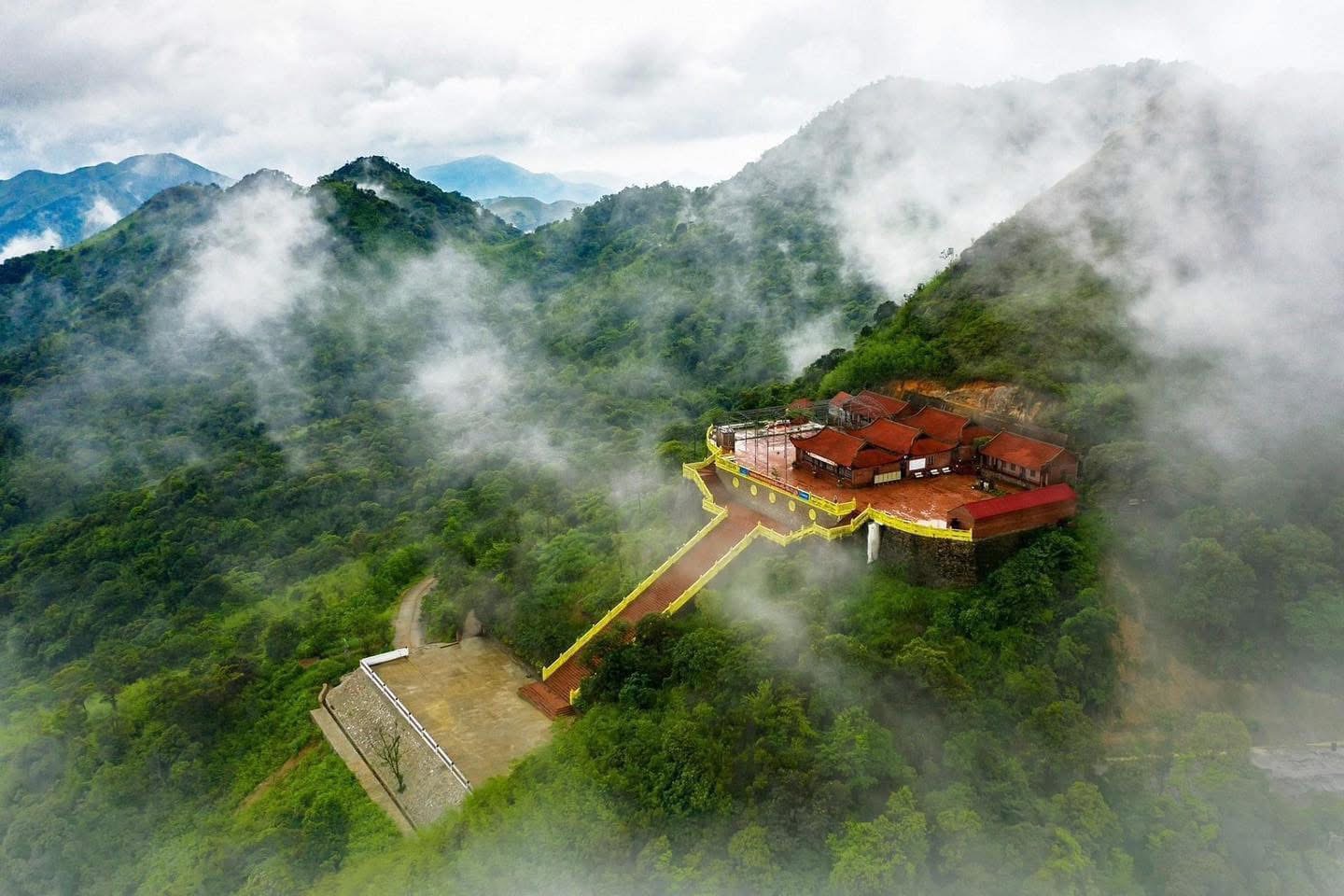
Ngoa Van Trung Pagoda – Ngoa Van Hermitage Relic Site
Discovery of a Relic Casket at a Former Enshrinement Site
According to historical records, there are at least seven locations where the relics of Emperor Buddha Trần Nhân Tông were enshrined.
The first is Ngoa Van, Yen Tu (now in Dong Trieu City, Quang Ninh Province) – the place where he entered Nirvana and where his disciples performed the cremation ceremony.
The second is Tu Phuc Pagoda within the Thang Long Imperial Citadel, whose exact location has not yet been identified.
The third is Bao Thien Stupa at Bao Thien Pagoda, located in the area of present-day St. Joseph’s Cathedral in Hanoi.
The fourth is Duc Lang in Tam Duong, Thai Binh (now in Tam Duong Hamlet, Tien Duc Commune, Hung Ha District, Thai Binh Province).
The fifth is Hue Quang Stupa (Patriarch Stupa) at Hoa Yen, Yen Tu.
The sixth is Pho Minh Stupa at Pho Minh Pagoda (now in Loc Vuong Ward, Nam Dinh City). In 1986, during restoration work, a stone casket was confirmed at the 11th level of the tower, which, according to historical descriptions, contained relics.
The seventh is at Quynh Lam – a major monastery and a training center for monks of the Trúc Lâm Zen sect – where two stupas enshrine the relics of Emperor Buddha Trần Nhân Tông.
Until before 2017, Pho Minh Stupa was the only site confirmed to still contain a relic casket of Emperor Buddha Trần Nhân Tông. In 2017, the University of Social Sciences and Humanities (Hanoi), in collaboration with the Quang Ninh Museum and Dong Trieu Town, conducted excavations at the Ngoa Van Hermitage site and discovered a relic casket. The Researchers archaeologists believe that these are the relics of Emperor Buddha Trần Nhân Tông.
Consulted experts all agreed that the metal box discovered at Ngoa Van Hermitage is a relic casket.

The metal box is believed to be a casket containing the relics of Emperor Buddha.
Most likely the relics of Emperor Buddha Trần Nhân Tông
Dr. Nguyễn Văn Anh stated that the primary objective of the 2017 excavation at Ngoa Van Hermitage was to search for traces of the Phat Hoang Stupa from the Trần dynasty, which was built by Pháp Loa (the second patriarch of the Trúc Lâm Zen sect) to enshrine the relics of Trần Nhân Tông at Ngoa Van.
The excavation results showed that restoration and renovation during the Later Lê period significantly altered the original layout of the Trần-era Ngoa Van Hermitage. Therefore, no remains of the original Phat Hoang Stupa from the Trần dynasty have been found.

However, the excavation team discovered an alloy box. Having previously studied relic caskets at Nhan Stupa (Nghe An) and other sites where the relics of Emperor Buddha Trần Nhân Tông were enshrined, Dr. Nguyễn Văn Anh suspected that this could be a relic casket.
He decided not to open the box but to preserve its original condition, as maintaining its integrity would hold multiple values, including spiritual significance if it were indeed a relic casket.
Instead, he followed proper procedures, reporting and consulting with researchers, including international scholars specializing in relic caskets found in China, Korea, and Japan.
To better understand its structure, the research team used X-ray imaging. The results revealed that the box consists of two layers (with another box inside). The innermost box contains two objects: one rod-shaped (resembling a bone fragment) and one round object (similar in structure and shape to a molar tooth).
Based on its form, structure (notably the “kim quan” style used in royal burial practices), size, and especially the objects inside, it is reasonable to assume that this is a relic casket. Since it was found at Ngoa Van—the place where the Emperor Buddha attained Nirvana—the research team believes it is highly likely to be the relic casket of Emperor Buddha Trần Nhân Tông.
“From studying this box, we found that it is unlikely anyone other than Trần Nhân Tông would have been accorded such burial rites.”
Further Research Continues
Commenting on Dr. Nguyễn Văn Anh’s announcement, Prof. Lương Gia Tĩnh – Vice Rector of the Vietnam Buddhist Academy – and Assoc. Prof. Dr. Tống Trung Tín – President of the Vietnam Archaeological Association – stated that the assumption that this is a relic casket of Emperor Buddha Trần Nhân Tông has reasonable grounds. However, to reach a definitive conclusion, further research is still necessary.
In response, Dr. Anh noted that in China, relic caskets have been discovered at many sites such as Dayun Temple (Gansu), Famen Temple (Shaanxi), and Leifeng Pagoda (Zhejiang). Based on historical records, these relics are identified as those of the Buddha. Nevertheless, there remain doubts about whether they are truly the Buddha’s relics, and such skepticism is a normal part of scientific inquiry.
According to Dr. Anh, the doubts regarding the relic casket found at Ngoa Van—whether it truly belongs to Emperor Buddha Trần Nhân Tông—are understandable and serve as motivation for the research team to seek more convincing evidence.
In 2022, the relic casket discovered by Dr. Anh’s team was ceremonially relocated and enshrined in the Phat Hoang Stupa at Ngoa Van—a structure built during the Later Lê period (1707).

Phat Hoang Stupa – The place enshrining the relics of Emperor Buddha Trần Nhân Tông at the Ngoa Van Hermitage Relic Site
In the same year, Ngoa Van Hermitage, Phat Hoang Stupa, and Doan Nghien Stupa were also restored. Quang Ninh Province also invested in developing connecting transport infrastructure to make the pilgrimage route to Ngoa Van more convenient.

Since 2019, visitors have been able to take a 2.1 km cable car to reach Ngoa Van.
Dr. Nguyễn Văn Anh also noted that a relic casket discovered during the excavation of Nhan Stupa site (Hong Long Commune, Nam Dan District, Nghe An) by the Institute of Archaeology in collaboration with the Nghe Tinh Museum (now Nghe An Museum) in 1985–1986 contained several items believed to be Buddha relics. In December 2017, this relic casket was recognized as a National Treasure.

 Ngày
31/07/2026
Ngày
31/07/2026


