


A DAY AT NGOA VAN ZEN VILLAGE: FROM SERENE DAWNS TO SUNSETS OVER ZEN TEA
I am not an early riser.
Every morning is the same alarm set for 6:30, snoozed until 7:15 before I finally sit up, drinking coffee in a rush, opening my laptop before my brain is truly awake. That has been my normal day for many years.
But that day I woke up at 4:45 AM, completely awake, without an alarm.
Not because I had changed. But because Ngoa Van Zen Village had done something to me in the previous 24 hours that I had not yet fully understood.
Here is the record of that day every moment, unfiltered, uncolored.
4:45 AM: When the Zen Village Is Not Yet Awake, But the Mountain Is Breathing
It was not quite dawn. The sky was deep blue a kind of blue that only exists for exactly 15 minutes before sunrise a color that city dwellers almost never see because at that time they are usually sleeping or looking at phone screens. From the retreat area of the Zen Village, I stepped outside.
No honking cars. No air conditioner hums. None of the urban background noise that we are so used to we don't realize it's there until it's gone.
There was only: the sound of wind through the bamboo rows. The sound of a stream somewhere down the slope. And my own sounds breathing, footsteps on damp earth. I stood there for about 10 minutes doing nothing.
For the first time in a very long time, I stood in one place without feeling I needed to do anything other than just stand there.
5:00 AM: Morning Meditation in the Truc Lam Zen Hall
The Zen hall opens very early. No one forces you to enter but the golden light shining from within, the faint scent of agarwood wafting out the door, felt like an invitation.
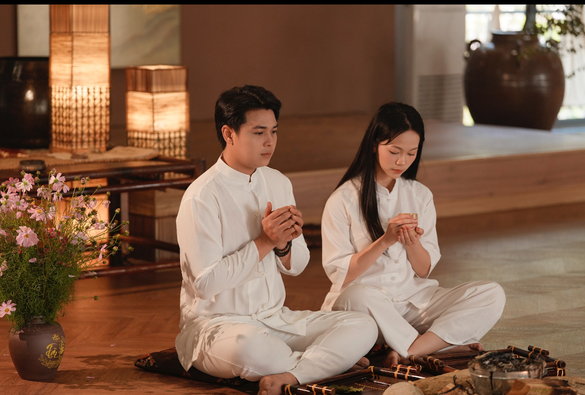
I went in. Sat down on a meditation cushion.
In front of me was the lacquer painting "Supreme Wisdom and Freedom" not flashy, not ostentatious, but there was something in the serene strokes that made you want to sit still and look for a long time.
The meditation instructor with a gentle, non-dramatic voice said only one sentence before starting:
"No need to try not to think. Just recognize when you are thinking, and gently return to your breath."
I breathed in. Breathed out.
For the first 20 minutes, my mind constantly jumped to: next week's deadline, unanswered emails, what I ate for dinner last night... Then I recognized it and returned to my breath.
By the 25th minute, something strange happened: the gap between thoughts grew longer. It wasn't complete silence but like the noise was turned down. And in that void, I heard the sound of the stream echoing from afar.
For the first time since the session began, I truly heard it.
6:00 AM: Cable Car Up to Ngoa Van Hermitage Like Flying Into Another World - Catching Sunrise on Bao Dai Mountain
The cable car station in the early morning was empty and quiet in a different way than at noon. The cabin glided up through the lingering mist and literally, there were stretches where the cabin went straight into white clouds, with nothing visible ahead.
That feeling suspended amidst the clouds, seeing no path forward, no path back strangely did not cause anxiety. It induced something akin to letting go.
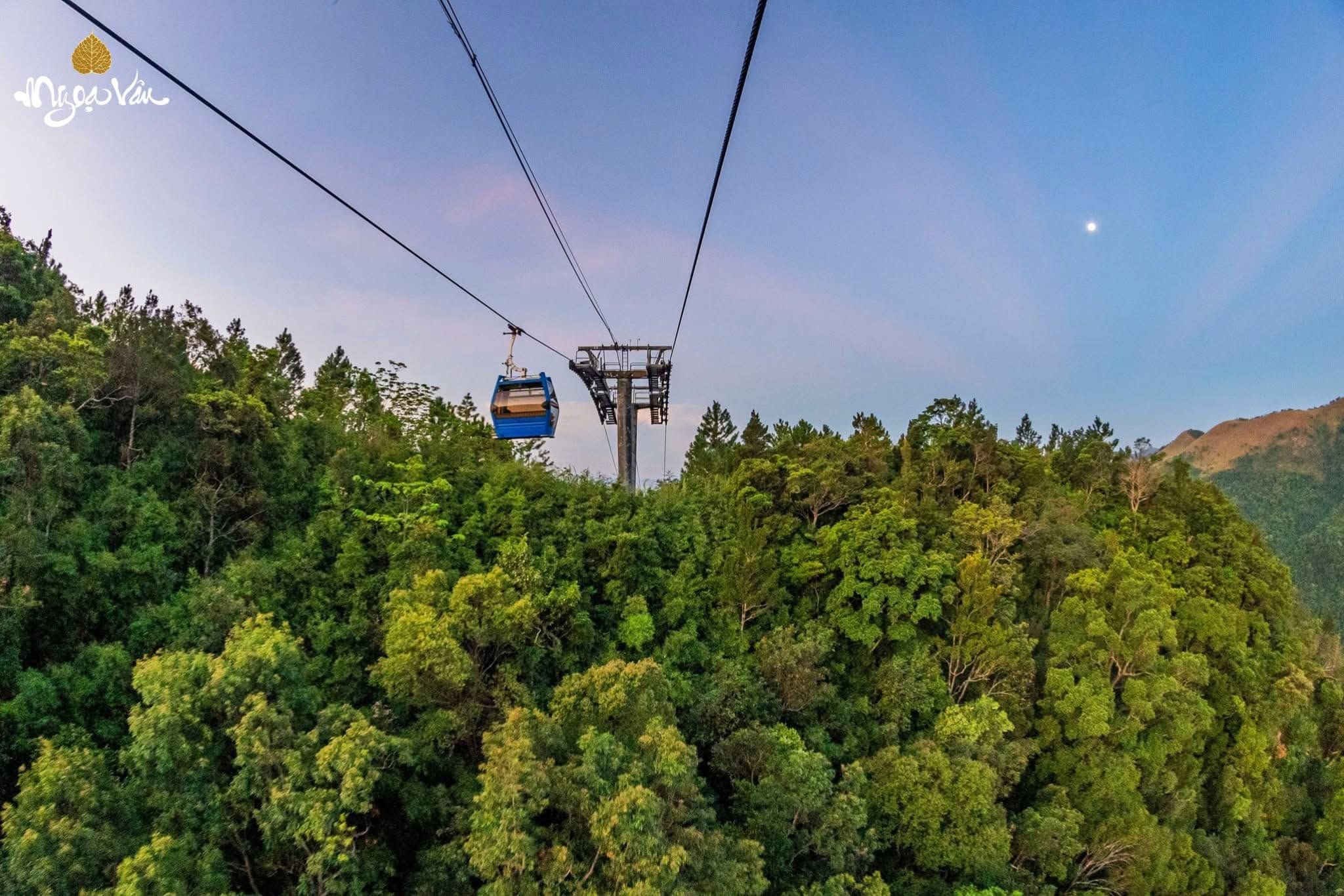
Upon reaching the top, the temperature was about 7–8 degrees lower than at the foot of the mountain. The mist was thicker. The bird songs were stranger species whose names I didn't know, singing in a way that only exists at this altitude.
The sun peeked out from behind the Eastern mountain range at 5:47 AM I remember exactly because it was the first time in many years I truly watched the sunrise, rather than taking a photo of it.
The first light of the day spilled over the overlapping peaks of the Yen Tu range, then gradually spread down the valley, then to the pine rows in front of me every canopy lit up as if ignited from within.
I thought of Buddhist Emperor Tran Nhan Tong.
Over 700 years ago, in May 1307, He ascended this Bao Dai mountain leaving the throne, leaving the palace, leaving everything the world considers power and fame to sit here, watch this sunrise, breathe this air.
I am not a king. I have nothing as grand to renounce as He did.
But in that moment, I understood something He probably understood: there are things you can only see when you stop long enough to look.
7:30 AM: Ngoa Van Hermitage - The Place Where Time Stands Still
I had seen photos of Ngoa Van Hermitage before coming and thought I knew what I would see.
But, I was wrong.
Not because the Hermitage is more beautiful than in photos though it actually is. But because photos cannot convey the atmosphere of this place. The feeling upon stepping in front of the Hermitage: like stepping into a different pressure zone. Not heavier or lighter it feels as if something in your chest has just been loosened that you didn't even know you were tightening.
The bronze statue of Buddhist Emperor Tran Nhan Tong in Nirvana posture lying on the altar in the Hermitage is so serene that just looking at it makes you feel more peaceful and at ease.

I sat down on a small stone bench near the Hermitage door, not bowing, not praying because I didn't know what to pray for just sitting in peaceful tranquility.
Clouds drifted by in patches like puffs of smoke at times obscuring the entire mountain range ahead and for a few seconds, the outside world completely disappeared leaving only the Hermitage, the Buddha stupa, and me.
I sat there for over an hour without looking at my watch once.
That is something that has never happened to me in at least the last 3 years.
9:30 AM: Upper Ngoa Van Pagoda and the Poem on the Stone Stele
Upper Ngoa Van Pagoda, located right next to the Hermitage, was built during the Tran Dynasty, restored by Zen Master Duc Hung during the Later Le Dynasty, and renovated in 2014, yet still retains its original essence.
There is an ancient stele in the pagoda courtyard, engraved with the poem "Bao Dai Mountain" by the Buddhist Emperor proof for later generations to know that Ngoa Van is indeed Bao Dai mountain, where He practiced asceticism and passed away.
I stood before the stele for quite a while. Unable to read Chinese characters but seeing the strokes still clear after more than seven hundred years of weathering, I thought: if something is deep enough, time cannot erase it.

The Buddhist Emperor did not leave behind magnificent palaces or mausoleums. He left behind poems, teachings, and a Zen lineage that still flows today. That is perhaps the answer to the question many of us are silently asking: what is worth leaving behind?
10:30 AM: Khoi Nguyen Slope - Hiking as a Meditation Practice
From Ngoa Van Hermitage up to Ban Co Peak the highest point of Bao Dai mountain one must pass through Khoi Nguyen Slope: a slope cutting through the lush green bamboo forest, hidden in the mist year-round.
I climbed alone, not listening to music, no podcasts just the sound of footsteps on the earth, rustling bamboo leaves, and my own breathing getting heavier as the slope got steeper.
There is something very Zen in hiking the right way: when the slope is steep enough, you cannot climb and think of other things simultaneously the body demands full attention to every step, every breath, leaving the brain no room for anxious thoughts.

In the past, many intellectuals and scholars passed through Khoi Nguyen Slope to reach Ban Co Peak, praying for success and academic achievement. I prayed for nothing, but when I set foot on the peak and stood in the natural clearing looking out in all four directions.
I understood why this is called the place where the Buddhist Emperor played the "Chess game of Life" for the nation of Dai Viet.
Looking down from here: overlapping mountains, endless green forests, not a single structure in sight, just earth, sky, and clouds. A feeling of smallness in a way that doesn't make you ashamed, but relieves you. Because when you realize you are small, all the worries you just had become small too.
12:00 PM: Vegetarian Meal at Ngoa Van Kitchen - Eating as an Act of Mindfulness
Descending the mountain, my stomach was hungry in a completely different way than after a meeting: this was the hunger of a body that had truly moved, truly been outdoors, truly lived.
Ngoa Van Kitchen serves pure Vietnamese vegan and macrobiotic cuisine the dining table is set near the window overlooking the forest and stream no TV, no background music.
I ate slowly not because I was intentionally practicing mindful eating, but because there was no rush. For the first time in a long time, I noticed the taste of each dish: the mild sweetness of boiled winter melon, the nutty flavor of silken tofu, the scent of ginger in the soup bowl.
Then the surprise dish was brought out: sweet potato vegan pizza and corn pizza. I smiled not expecting pizza amidst a sacred mountain. But taking a bite: crispy crust, naturally sweet filling, without any artificial flavoring. Unique in taste, but not out of tune it still retained the vegan spirit, just donning a modern cloak.
During that meal, I didn't look at my phone once.
2:00 PM: Forest Bathing - A Lesson from the Japanese
The Japanese have a practice called Shinrin-yoku forest bathing: it is not walking with a destination, but wandering slowly in the forest, letting the senses absorb everything the scent of pine resin, the green of the canopy, the sounds of wind and water.
Studies on Shinrin-yoku show that just 20 minutes in the forest can significantly reduce blood cortisol levels the stress hormone.
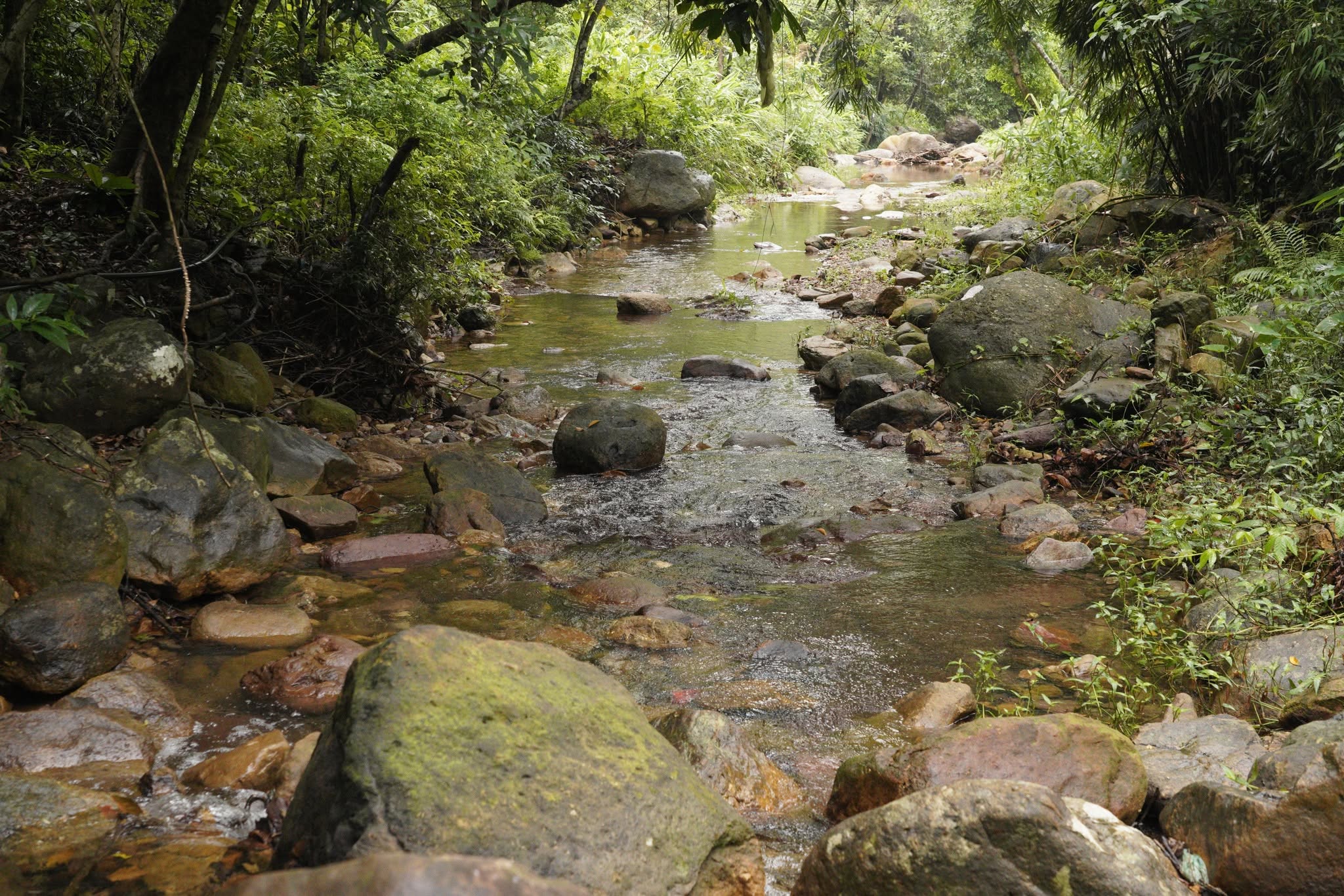
I didn't know this when I stepped into the Zen Village's pine forest that afternoon. But 30 minutes later, sitting down on a rock by the small stream and feeling the coolness rising from the icy water I felt the change inside me.
It wasn't a grandiose emotion, just: light, truly light as if someone had just taken away something I had been carrying for a very long time without remembering since when.
I sat by that stream for nearly an hour doing nothing, thinking nothing consciously just listening to the flowing water.
3:15 PM: Tea meditation in the Truc Lam Zen Hall
Afternoon tea at the Truc Lam Zen Hall began at 3:15 PM.
The tea was brewed in an unglazed dark brown terracotta teapot, retaining heat and guiding the aroma in a way no other pot could. Poured into a small ceramic cup, the amber tea color shone in the late afternoon light streaming through the window. I raised the teacup, the warmth transferring through my palms. Taking a breath of the tea the scent of flowers and earth, the scent of something ancient and peaceful.
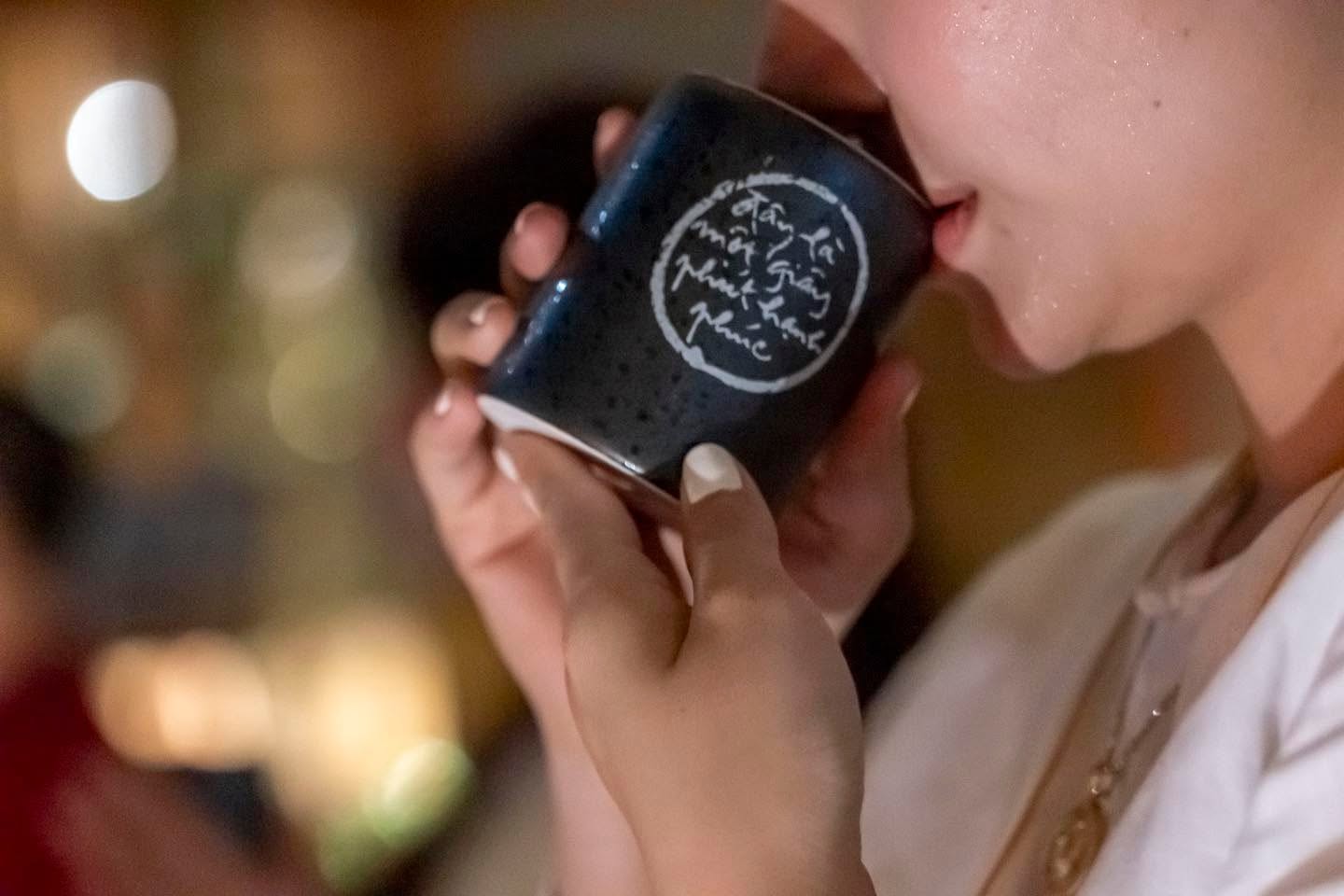
Taking a small sip, Slowly.
And I thought: this, this is the moment I didn't know I needed until it happened.
Not an epic moment, not an epiphany just one person, one cup of tea, and the feeling of being completely present in that very moment not thinking about having to recount it to anyone, not worrying it would pass, doing nothing but living it.
The Buddhist Emperor wrote:
"This spring is discovered by me Sitting silently to watch a rose petal."
I understood that poem for the first time not with my head, but with my body.
4:45 PM: Sunset at Middle Ngoa Van Pagoda The Moment I Want to Keep Forever
Middle Ngoa Van Pagoda is located on the southern mountainside at an altitude of 588–644m featuring a "Nhi" (二) character architecture, two buildings (Front and Rear Halls), with a red jade statue of the Buddhist Emperor placed in the front a deep red, not ostentatious, but profound.
In the afternoon, the sunlight slanted through the Rear Hall's windows, casting diagonal streaks of light on the brick floor. The Three Jewels altar in the center. On both sides are Samantabhadra and Manjushri Bodhisattvas symmetrical and balanced in a way that makes the whole space exude tranquility.
I sat in the Rear Hall for about 40 minutes. No one else was in the room. Just the afternoon light, a faint scent, and complete silence a silence that wasn't empty but full. The sunset was casting a yellow-orange hue on the mountain peaks. The pine forest turned from green to deep green, a white late-day cloud drifted by slowly as if reluctant to leave.
6:00 PM: Before Returning: What I Took With Me and What I Left Behind
On the way to the cable car station to descend the mountain, I stopped to look back at the Zen Village complex one more time.
The golden lights began to light up in the Zen Hall. The incense smoke from Ngoa Van Hermitage blurred through the evening mist. The temple bell rang once a sound spreading across the mountain forest then fading into silence.
I didn't bring back any physical items, didn't buy souvenirs, didn't take any stones or flowers.
But I brought back something harder to name the feeling that stayed within me all the way back to Hanoi, in my sleep that night, and was still there the next morning when I woke up at 4:45 AM without an alarm.
A silence that is not empty. Something like knowing exactly who I am even if only for a day.

 Ngày
31/07/2026
Ngày
31/07/2026


